Version: 1.0
Date: 07 February 2026
1. Purpose
NeuroDiverse Community CIC is committed to creating a fully inclusive environment for children, young people, and adults with Special Educational Needs and Disabilities (SEND) or neurodivergent profiles. This policy outlines our approach to ensuring equity, accessibility, and empowerment in line with:
● The SEND Code of Practice (2015), which emphasises person-centered planning, early identification, and collaborative support.
● The Equality Act 2010 and UK disability rights, which guarantee protection from discrimination and promote reasonable adjustments.
Our aim is to ensure that all participants can access meaningful opportunities, contribute their strengths, and thrive within our programs.
2. Scope
This policy applies to:
● All participants, children, young people, and adults accessing our services.
● Staff, volunteers, and contractors engaged with NeuroDiverse Community CIC activities.
● Partners and external organisations collaborating on inclusion or SEND-related initiatives.
3. Principles
NeuroDiverse Community CIC operates according to the following principles:
1. Neuro-affirming practice – Recognising neurodivergence as a natural and valuable form of human diversity; support is designed to adapt environments and processes, not to “normalize” participants.
2. Person-centered approach – Decisions about participation, support, and accommodations are made collaboratively with the individual and, where appropriate, their family or advocates.
3. Inclusive participation – All programs and activities are accessible and designed to remove barriers to participation.
4. Early identification and support – SEND needs are identified proactively and addressed through reasonable adjustments and specialist support where required.
5. Rights-based framework – Upholding the rights of individuals with disabilities to equality, dignity, and autonomy.
4. Identification and Assessment
● Initial Assessment – All participants are invited to share information about their needs, preferences, and access requirements at the outset.
● Ongoing Monitoring – Staff and volunteers monitor engagement and wellbeing, identifying emerging needs in alignment with SEND Code of Practice guidance.
● Collaboration – Where appropriate, assessments are supported by parents, carers, educational providers, or healthcare professionals.
5. Support and Reasonable Adjustments
● Individual Support Plans (ISPs) – Personalised plans are developed for participants requiring additional support, detailing adjustments, accommodations, and strategies.
● Accessibility Measures – Environments, materials, and activities are adapted to be inclusive, e.g., alternative communication methods, sensory considerations, flexible scheduling.
● Staff Training – All staff receive mandatory training on neurodiversity, disability awareness, and inclusive practices.
6. Anti-Discrimination and Inclusion
● NeuroDiverse Community CIC strictly prohibits discrimination, harassment, or exclusion on the basis of disability or neurodivergence.
● Reasonable adjustments are provided to ensure equitable participation, in accordance with the Equality Act 2010.
● Individuals are supported to self-advocate and have their preferences respected.
7. Safeguarding and Wellbeing
● All participants are entitled to a safe, supportive environment that meets safeguarding standards.
● Any concerns relating to SEND or disability, including unmet needs, bullying, or exclusion, are addressed immediately in line with our Safeguarding Policy.
8. Collaboration and External Services
● NeuroDiverse Community CIC collaborates with schools, local authorities, healthcare professionals, and disability organisations to ensure continuity of support.
● Referrals to specialist services are made when necessary, with consent, to enhance participation and wellbeing.
9. Monitoring and Review
● This policy is reviewed annually or sooner in response to legislative changes, best practice updates, or feedback from participants.
● Feedback from participants and families is actively sought to ensure the policy remains responsive and inclusive.
10. References
● SEND Code of Practice: 0 to 25 years (2015) – Department for Education & Department of Health
● Equality Act 2010 – UK Government
● Children and Families Act 2014 – Part 3, SEND provisions
● UN Convention on the Rights of Persons with Disabilities (UNCRPD) – ratified by the UK
Approval:
Name: Kirsty Northam
Role: Director, NeuroDiverse Community CIC
Date: 07 February 2026
NeuroDiverse Community CIC
Neuro-Affirming Inclusion Checklist
Purpose: Ensure all participants with SEND or neurodivergence can engage safely, meaningfully, and comfortably in all activities.
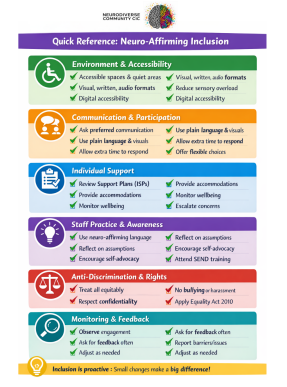
1. Environment & Accessibility Check that physical spaces are accessible (ramps, clear signage, quiet areas). Provide alternative formats for materials (visual, written, audio). Reduce sensory overload where possible (lighting, noise, space). Ensure digital platforms are accessible (screen readers, captions, keyboard navigation).
2. Communication & Participation Ask participants how they prefer to communicate and interact. Use plain language, visual supports, or social stories where helpful. Allow extra time for responses and activities. Respect participants’ choices about participation; offer flexible options.
3. Individual Support Review any Individual Support Plans (ISPs) before activities. Provide requested accommodations consistently. Monitor engagement and wellbeing during activities. Escalate concerns promptly to safeguarding lead or line manager.
4. Staff Practice & Awareness Use neuro-affirming language; avoid pathologising differences.
Reflect on your own assumptions about ability, behaviour, and communication. Encourage self-advocacy and autonomy for all participants. Attend ongoing training in SEND, disability awareness, and inclusion.
5. Anti-Discrimination & Rights Treat all participants equitably; no tolerance for bullying, harassment, or exclusion. Apply the principles of the Equality Act 2010 in all interactions. Respect confidentiality and obtain consent before sharing personal information. Collaborate with families, carers, and external services as needed.
6. Monitoring & Feedback Observe and document participation and engagement. Seek participant feedback regularly on comfort, accessibility, and inclusion. Report barriers or recurring issues to management for review. Review and adjust practices in line with policy and participant needs.
Reference: SEND & Disability Policy, NeuroDiverse Community CIC
Remember: Inclusion is proactive, not reactive. Small adjustments can make a big difference.