Early Years Foundation Stage SEND and Early Intervention Policy
Policy Review: Annually or sooner in response to legislative changes or operational needs.
Next Review Date: 07 February 2027
Approved By: Kirsty Northam, Director
Policy Statement
NeuroDiverse Community CIC is committed to providing an inclusive, nurturing, and equitable environment for all children, including those with Special Educational Needs and Disabilities (SEND). We recognise that early identification and intervention are critical in
supporting children’s development, learning, and wellbeing, in line with the SEND Code of Practice (2015), Children and Families Act (2014), and the EYFS Framework (2021).
1. Aims
● Ensure all children, regardless of neurodivergence or disability, receive appropriate support to reach their full potential.
● Identify and respond to SEND as early as possible through observation, assessment, and collaboration with families and professionals.
● Promote a culture of inclusion, respect, and dignity for children, families, and staff.
● Work closely with parents, carers, and external agencies to plan and deliver individualised support.
● Maintain compliance with statutory requirements and best practice guidance in EYFS and SEND provision.
2. Definition of SEND
A child has SEND if they have a learning difficulty or disability which calls for special educational provision to be made for them, including support for:
● Communication and interaction difficulties (e.g. hearing loss, autism spectrum conditions, speech and language delay)
● Cognition and learning difficulties (e.g., developmental delay, dyslexia)
● Social, emotional, and mental health difficulties
● Sensory and/or physical needs (e.g., hearing, visual, or mobility impairments)
3. Early Identification and Assessment
● All children are observed and assessed regularly using EYFS Early Learning Goals (ELGs) and ongoing formative assessment.
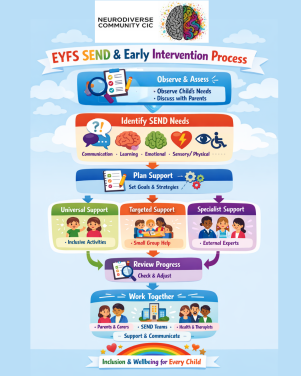
● Staff are trained to recognise developmental delays or differences and follow the graduated approach: Assess – Plan – Do – Review.
● Information is gathered from:
○ Observations and assessments within the setting
○ Discussions with parents and carers
○ Relevant professionals (e.g., health visitors, speech and language therapists)
4. Provision and Support
● Universal support: High-quality teaching and inclusive practice for all children.
● Targeted support: Small group or individual interventions designed to address specific needs.
● Specialist support: Access to external agencies and professionals when needs cannot be met within the setting alone.
Examples of support strategies:
● Adapted learning resources
● Visual schedules and social stories
● Speech and language programmes
● Sensory regulation tools
● One-to-one support as necessary
5. Partnership with Families
● Parents and carers are considered partners in planning and decision-making.
● Regular meetings are held to discuss progress, strategies, and interventions.
● Families are supported to access external assessments or specialist services if needed.
6. Collaboration with External Agencies
● NeuroDiverse Community CIC works closely with:
○ Local Authority SEND teams
○ Health professionals (e.g., paediatricians, therapists)
○ Early Intervention services
● Multi-agency meetings (e.g., Early Help, Team Around the Child) are attended when appropriate to ensure consistent support.
7. Staff Training and Professional Development
● All staff receive regular training on:
○ EYFS framework and SEND requirements
○ Early identification of developmental differences
○ Inclusive teaching strategies and differentiation
○ Safeguarding and child protection
8. Monitoring and Review
● Children’s progress and intervention plans are reviewed at least termly.
● The effectiveness of the policy is evaluated annually by the management team.
● Adjustments are made based on:
○ Observed outcomes
○ Feedback from families
○ Guidance from external professionals
9. Inclusion and Dignity
● Every child is treated with respect, dignity, and sensitivity.
● Adaptations are made to routines, environments, and resources to ensure full participation.
● Staff follow protocols for personal care and support that safeguard the child’s dignity and comfort.
10. Safeguarding
● All staff adhere to the NeuroDiverse Community CIC Safeguarding Policy.
● Concerns about a child’s wellbeing, including potential abuse or neglect, are reported immediately to the Designated Safeguarding Lead (DSL).
● Support for SEND children is integrated with safeguarding practices.